





Hard data first today, though market futures were already in the pits — options expiration, border politics, housing arithmetic, and another Fed data drop all lined up in the same morning traffic jam.
Retail sales and housing numbers gave us the first hint that the consumer is not wading in deeper now. Is the Viagra effect of consumer spending wearing off? That tees up this morning’s Housing Starts report just crossing:
Housing Starts
Privately-owned housing starts in June were at a seasonally adjusted annual rate of 1,427,000. This is 19.0 percent (±15.9 percent) above the revised May estimate of 1,199,000 and is 3.5 percent (±14.3 percent)* above the June 2025 rate of 1,379,000.
19% sounds like a blowout to the upside. But not so much when you look at the big picture:
Later, the Fed’s G.17 industrial production and capacity-utilization numbers will hint at whether consumer spending was anticipated or if there are inventory builds ahead.
Housing is the bigger story for the first cup, though. Let’s all pretend we can build a nation on building McMansions for one another. While, at the same time, the “secure border” begins reducing the flow of first-time homebuyers who help prop up demand for the upwardly mobile.
That doesn’t mean housing collapses tomorrow morning. It’s just a crack in the foundation.
That brings us to the political edge of the same problem: population flows, housing pressure, labor supply, service demand, and who gets to call “growth” when the numbers are being propped up by churn rather than prosperity.
Trump: Bordering On…
The credentialed left has been banging the drum over Trump’s latest border-security push, complete with supporting data and dire warnings about democracy, elections, and civil liberties.
“As one assessment puts it: “We judge that U.S. adversaries, including at a minimum Russia, China, Iran, and North Korea, as well as non-state groups, have the capability to compromise U.S. election infrastructure.”
Fair enough. Election infrastructure should be secure. So should the border. So should the financial system. So should the power grid. So should the voting rolls. The oddity is that the same people who will spend six hours hyperventilating over Russian bots will often spend six seconds waving away mass identity, housing, labor, and security consequences at the border.
Trump’s line, stripped of the carnival bark, is simple: if the house is on fire, call the fire department and take away the matches. We know — too simple. But sometimes simple is what remains after decades of policy (bullshit) fog lifts.
There are two broad camps on the open-border front. One camp genuinely believes borders are moral inconveniences and that national membership should dissolve into a kind of global pass-through lane. The other camp monetizes the inflow: cheaper labor, more renters, more customers, more political clients, more nonprofit grants, more institutional budget justification. Between the missionaries and the middlemen, the country is expected to keep smiling and paying.
Europe already ran the experiment at scale. The Schengen area — 29 countries with internal-border-free travel — was sold as a grand European dream of frictionless movement. For tourism and business travel, it had obvious appeal. But borderless ideals become harder to maintain when migration pressure, terrorism risk, overstays, fake papers, and crime networks begin using the same open channels as holidaymakers and truckers. Oops.
Now Europe is patching the dream with digital gates. The new Entry/Exit System registers biometrics — fingerprints and facial scans — for non-EU visitors, intended to track stays, combat overstays, and tighten the outer perimeter. ETIAS is another layer in the same direction. Meanwhile, several EU members have reintroduced or extended internal border checks, citing migration pressure, security, and terrorism risk. In plain English: the borderless dream is getting borders bolted back onto it.
That is the lesson. Open borders do not eliminate borders. They move them inward. They move them into neighborhoods, welfare offices, police departments (the Chinese set up their own in Canada!), hospitals, schools, housing markets, wage markets, and voting systems. The checkpoint does not vanish. It multiplies.
The left likes to call the visible growth “vibrancy.” More people, more spending, more demand, more GDP points, more paper motion. Under the waterline, the costs are harder to print in a liberal campaign brochure: housing stress, wage competition, cultural friction, overloaded courts, shadow employment, identity fraud, and police no-go-adjacent zones where the formal state has to ask permission from informal power.
Y’all have fun with that.
For anyone still riding the open-borders bandwagon, allow us to simplify the rhetoric: open borders are the civic equivalent of turning off your antivirus and dousing the firewall.
Yes, the machine will still run for a while. It may even seem faster without all those annoying security checks. But sooner or later, the payload arrives.
You live on Liberty Island – the lifestyle center of the universe. Open your eyes now. It’s under attack.
News Compressor On
Sans Trump? Weekend War is still the biggest risk forward to Monday:
Today’s verified changes are the wider Gulf/Syria strike pattern, collapse in Hormuz traffic, confirmed Texas fatalities and rescue scale, the semiconductor rout, widespread smoke, the lettuce-source identification and Fairlife production shutdown.
What changed overnight is continued U.S.-Iran military exchanges with additional strikes and enforcement of the naval blockade on Iranian ports, alongside persistent oil price volatility around the $84–86 range. U.S. Central Command reported further operations targeting Iranian coastal defenses, missile sites, and naval assets near the Strait of Hormuz and locations including Bandar Abbas and Qeshm Island. Iran claimed responses against regional targets and shipping, with the waterway’s status remaining contested and traffic reduced.
Domestically, wildfire smoke from Canadian and western U.S. fires affected air quality across the Midwest to East Coast, prompting health advisories to stay indoors.
Fairlife—the Coca-Cola-owned maker of ultra-filtered milk and Core Power protein drinks—temporarily suspended its U.S. production operations on July 16 after an outside party gained unauthorized access to systems connected with production.
No major new U.S. mass-casualty disasters (3+ deaths, line-of-duty, or major declarations) stood out overnight beyond ongoing heat/wildfire/flood risks noted earlier this week. The Texas Hill Country remains at flood risk…
News Forecast – Crash Risk
Peoplenomics subscriber note: Crash Risk Today and Monday
In Elliott wave terms, we can see in our 1929 replay work that the market seems to have had a top, then a wave 1 down, a complex wave 2 which may complete now:
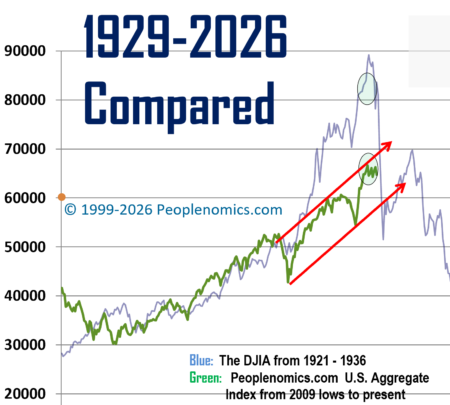
The risk tips if the Dow drops more than 500 today. Post-mortem on today’s action in tomorrow’s Peoplenomics ChartPack.
Refer to the long-term Reserve Liquidity notes from the NY Fed out today at Reserve Demand Elasticity. Timing may be ironic. We shall see.
12–96 Hour Outlook
U.S.-Iran strikes/blockade enforcement likely to continue short-term with potential for further shipping disruptions or retaliatory actions; oil supply risks and prices remain elevated, mattering for U.S. energy costs and inflation—outcome could shift on diplomacy or de-escalation signals (65%).
- Wildfire smoke and fire weather in the West/Midwest may worsen air quality and fire risk with heat/dry conditions; NWS hazards monitoring key (70%).
- Potential for scattered severe weather/flooding in vulnerable U.S. regions amid summer patterns (55%).
- Markets: Earnings season and Fed-related data flow could drive volatility; oil/geopolitics as overlay (75%).
- Ukraine/Russia: Ongoing strikes reported but no major overnight shifts noted in scan (60%).
- Broader supply chain: Hormuz tensions may delay or reroute energy/shipping, with U.S. consequences in fuel prices (68%).
Personal Action _NE-USA
Major wildfires, primarily in Canada and the western U.S., are sending dense smoke plumes eastward. Forecasters expect unhealthy air quality to spread into the Northeast this weekend, with officials in affected areas recommending masks for outdoor activities to reduce inhalation of fine particulate matter (PM2.5).
Why Masks Help Here
- Particulate Reduction: Well-fitted masks can filter a high percentage of airborne particles, significantly lowering exposure to wildfire smoke’s toxic mix of soot, chemicals, and irritants that aggravate asthma, heart/lung conditions, and general inflammation.
- Practical Edge for Seniors/Active Folks: At 77 and in good physical shape with regular outdoor work (mowing, brush hogging, etc.), even short exposures add up. Masks provide a simple, low-cost layer—especially useful during exercise or chores when breathing rate increases.
- For Improved Results: You may wish to go with an N100 mask, but the valved kind is our preference because it reduces exhale backpressure, making it more comfortable for extended wear or physical activity.
Limitations & Best Use: Masks don’t block gases like ozone or VOCs entirely, so combine with staying indoors during peak smoke, using HEPA air filters, and monitoring AirNow.gov or local alerts. Change masks if they get damp/dirty.
Bottom Line: Mask up for necessary outdoor time this weekend to protect respiratory health and keep your routine going without unnecessary setbacks. Check real-time AQI before heading out—better safe than dealing with flare-ups. Stay vigilant on the broader fire/smoke pattern as it evolves.
Around the Ranch: Lifelong Learning Curve
Very interesting invite showed up in my LinkedIn account today: An invite to apply for the Wharton CRO program. That’s Chief Revenue Officer.
Actually sounds like a good track, too: Because we have written a lot about low-level drivers of revenue change. Like the one coming when all this frenetic AI spending is actually spent and all the vendors have been paid. We sense huge risk – because by then global depression could be game-on – that there will not be enough money to pay for all the spending.
That’s useful from a long-term revenue standpoint, because it is a semi-definable risk most people never think through. I’m pretty sure it’s the kind of thing soft-pedaled in Silicon Valley pitch decks.
That Triggered Neurons Flow
I’m half-way through year 78 – the finish line comes in February. While it’s nice to be on a Wharton email list, it got me to thinking about when – as we age – it’s time to start changing emphasis.
The “soft learning curve” in life is simple to sketch out: We are born on a strange planet. By Age 5 or earlier we are in 100 percent learning absorption mode. By the time grad school is done, you’re in the Do Window of life. But even here, the learning curve doesn’t go to zero, or your income will drift thataway, too.
That, in turn, teed up a long-held belief. One that was central in my book Packing to Die – the Suitcase Between Your Ears.
At what point do we each “stop learning?”
Obviously, the correct answer is Never! Just yesterday, I learned that my 2021 Hessaire swamp cooler used a different fan motor than the 2019 (and earlier). Who knew, right?
But taxiing out onto the runway before take-off to the Great Hereafter, it occurred to me that knowing what year the fan model break happened is actual learning, but it’s likely to be a one-time use. I simply may not live long enough to need it again. (That could happen – the other evap cooler could lose a fan in the greenhouse, but the odds… OMG long, right?)
That means something personal (and maybe useful). As we get older, it becomes clear that the only “learning” we take with us is the “stuff between our ears.” And so, after what age do we stop collecting transient knowledge and begin collecting universal knowledge? I mean of the sort that is durable down at the soul level.
Filter: What kind of learning in Life will be useful over in “Next”?
I don’t know why, but the fan model-year might be one of those things I can now safely forget.
Speaking of Fans?
That IBM Selectric II I bought for Elaine is still in USPS’ private corner of hell. I told you about this in the Thursday column here.
Today we learn the computer-based butt-covering window has arrived. Being informed now that
Thu, Jul 16 12:00am In Transit to Next Facility, Arriving Late
This doesn’t mean it’s really out of Kansas. Because there’s no outbound scan from Kansas yet.
Wed, Jul 15 4:57am Arrived at USPS Facility OLATHE, KS 66061
This does provide us with a short-course on data ambiguity – “In Transit” is a wonderful pantload of lawyer-speak. (At this rate, I may have a good start on a new website idea: “Missing_Texas_Packages.com.” Which I would do, except I don’t know as I could handle that site becoming more popular than this one.)
eBay is considerably more honest. “Delivery is taking longer than expected.” Yah think?
I’m going out and look at that long runway again.
Write when you get something in the mail,
Consider subscribing to our deeper work.
Read the full article here