



“Work expands to fill the time available” has been getting another ranch-sized proof around here this weekend.
Next weekend, ham radio bugs (and keyers – that’s a joke, get it?) head out into the wilds for the ARRL;s Field Day 2026. Contest Rules here, said old George, AC7X, electron boss extraordinaire. “With so many hams lining up tools for FD26, it would be in keeping with the spirit of things to sorwt out my electronics tools.
That’s how this weekend’s “innocent starting point” landed on tool organization. I wanted to specialize several toolboxes for electronics better. I should have noticed the quicksand when the thought passed by…
The shop already has multiple roll-arounds, each with a reasonably well-defined mission. Green are the general shop-work rollers. Electric blue, naturally, is electrical: solar connectors, pigtails, wire, Alexa-controlled switches, 4/0 cable cutters, and the other specialized goodies that accumulate whenever electrons are involved.
Then there are three black boxes. Or perhaps five. Organization becomes somewhat theoretical at this level.
Drawers Tools Call “Home”
One black box roller drawer contains jewelry-making supplies in case Elaine gets back into that play mode. If you need a ring-sizer or leatherwork tooling, you’ll find it here.
Beneath it is a welding drawer containing the smaller consumables: .030- and .035-inch tips, plasma-cutter guides, and related pieces too small to deserve their own cart.
Another drawer is “Sharps.” That is where the picks, pulls, scrapers, specialty knives, and other implements of precise destruction live. Need a 12-inch razor scraper to remove an expired vehicle inspection sticker? Sharps knows where it is.
Above the main bench is a tool rail with air and plenty of electrical outlets. Elsewhere is the charger-and-battery bench because, despite all my lectures about standardization, there appears to be no known way to operate a well-stocked shop without ten different battery chargers.
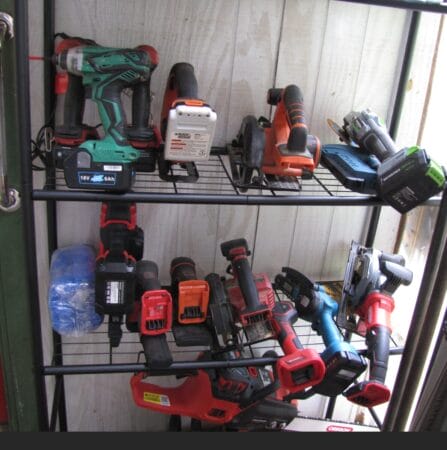 Here’s how this “organizational indexing nightmare” plays out here.
You begin by shopping the sales (Amazon Tool Slut Days in coming next week!).
Then you try to get all the tools charged and ready so you can grab and go on a moment’s notice.
But, if you’re sharp-eyed, you’ll notice there is something missing in the picture.
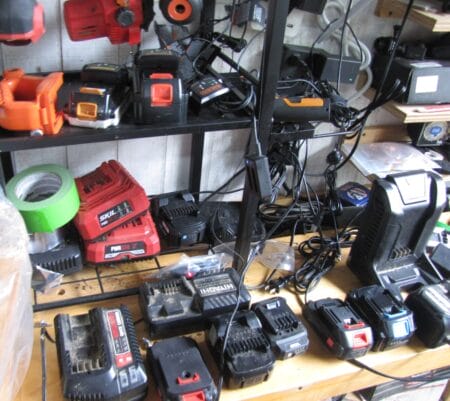 That would be the Charger Bench.
This was set up a long time ago because I needed to keep the (*GD) chargers away from the table saw, jointer, handsaw and so forth.
Plus, you don’t want them hogging the precious tiny clear horizontal postage stamp working bench. Oh, no, that would never do.
So the “Charger Bench” came along. And it is a great fit with my “If you put it in your path and therefore make it part of your routine, you can do a quick temp check and put batteries on or off as needed.
Sometimes Organization Backfires
Tools one place, chargers adjacent – that part makes sense. But here’s an example of how this kind of tool organization blows up. See, I started with a simple concept “The Sharps Drawer.”
The first (original) “Sparps” drawer is still in use.
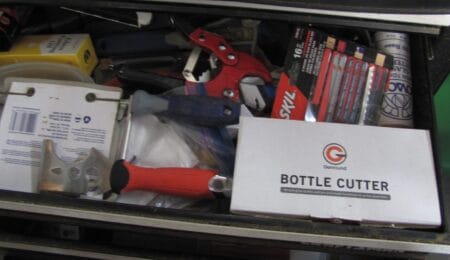
If you need their 12 inch handle razor scraper for the emissions sticker change in the impossible-to-reach windshield area, look here. Or, next drawer down – “Sharps 2.” In this one, I noticed a 10 inch gas weed whacker brush blade. So that led to “Sharps 3” opening in a different roll-around…
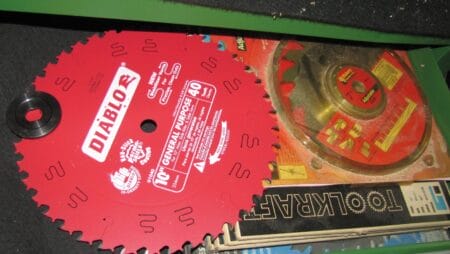
And once that happened – and wobble-dado blade moved in, then the better quality dado set wanted to be nearby. So it took up residence in “Sharps 4” because 3 wasn’t deep enough.
See where this is going? Every tool brings with it this incredibly understated tool location and indexing issue. Drill bits are the same problem: Do you leave all the drill bits at the Drill Press Station, or do you keep another tool box of drills at the main bench? Maddening…seriously. Then,l where do you put the Drill Doctor to sharpen them all? Dang!
AI Helps Only Somewhat
Now back to the ham radio tool kits problem.
My original plan sounded simple. I would give the AI stack the contents lists from several good electronics toolkits, including a high-end Jensen winged case I bought empty on eBay. The machines would sort the tools into two logical kits.
The Jensen would become the electronics measuring, troubleshooting, and alignment kit. A second case would become the fabrication kit: portable enough to take outside for antenna construction and other light fabrication work, but stopping well short of the heavy welding carts.
Simple. Logical. Almost elegant.
Then all the tools arrived.
Once they were spread out, it became obvious that the toolkits were going to consume the workspace they were supposed to improve. That was when photographic memory finally did something useful and hauled up an old image: the smart mechanics in a transmission shop.
A good transmission shop does not carry a complete Hydra-Matic onto a delicate rebuilding bench and begin swinging tools. The mechanic first puts the heavy unit on a stout teardown bench. There it is drained, opened, and broken into manageable assemblies. Those components then move to specialized benches for inspection, measurement, adjustment, and rebuilding.
That was the missing piece.
Begin by Understanding Your Workflow
You might need more than one electronics bench – and this is where I screwed up. Seriously.
Most of my ham gear is older tube-type equipment weighing anywhere from 20 to 120 pounds. Moving a Johnson Thunderbolt linear amplifier onto a genteel electronics bench is not merely inconvenient. It means the bench is being asked to serve two physically incompatible jobs.
Old heavy iron tube-type gear with a smattering of smaller than rice surface mount (SMT) projects.
What I needed was a halfway-house bench: a heavy, stand-up, walk-around workspace where large equipment could land, be opened, cleaned, diagnosed, and broken into workable sections if needed before anything delicate began.
I kicked the problem around with my AI stack. One of them, probably my local LMS 7B model Walter, finally asked the domain question:
“Why are you mixing a solid-state and surface-mount bench with the linear-amplifier gear?”
That was the lights-coming-up moment. This really was a “Well, shit, because I have always done it this way for 77-years?” moment.
In my head, a modern two-pound DSP radio such as the Hermes Lite 2 and a roughly 120-pound Johnson Thunderbolt occupy the same domain. They are radios. Signals enter, circuits do their magic, and signals leave. My logical model follows the operating domain without caring very much at all about the size (and weight) of the box.
But the physical domain certainly cares.
So does complexity. Because if I shoehorn all the electronic tools into one area, there’s no space left to work on gear. It’s not that I’m stupid, at least exactly…
Pilots deal with something similar. Whether flying aerobatics in a Citabria or driving a Boeing 767, the underlying control domain remains pitch, roll, yaw, power, trim, and energy management. The aircraft may be vastly different, but from the pilot’s perspective much of that difference appears as a new user skin wrapped around familiar principles.
Without realizing it, I had applied the pilot’s mental model to my electronics shop. A radio was a radio, so naturally radio work belonged on the radio bench. Regardless of size, I plug in a key and get on the air – or wake up early and get on 80 meters to chat around with friends.
What the Russian TRIZ practitioner in me should have remembered is called an “Internal Contradiction.” Rebuilding a 120-pound Thunderbolt right on top of a hot-air rework station and 10-inch SMT microscope is like changing tracks on an M1A2 Abrams on the same bench where you install Swiss watch jewels and balance wheels. Everything involved may loosely qualify as machinery, but the similarity ends there.
The solution is still evolving as I write this. A sturdy walk-around bench in the shop will become the radio intake and teardown station. It will have the hand tools and basic test equipment needed to troubleshoot signals through 30 MHz.
It does not (“should” not) need serious component-identification horsepower, a hot-air soldering station, an SMT microscope, or every feature of the main dual-trace scope. We can leave the SMT tweezers.
Those belong at the precision electronics bench, where smaller assemblies can be measured, repaired, aligned, and returned to service without sharing elbow room with a hundred-pound amplifier cabinet.
Oddly enough, I had already begun making this distinction elsewhere without recognizing the larger rule. (Male Pattern Stupidity?) I can’t be sure, but… I moved a borescope and a seven-inch LCD magnifier on an adjustable arm to the hobby bench. That is where the Hoppe’s No. 9 lives for gun cleaning and trigger work.
G2 prefers a lighter trigger pull than I do. Father-and-son differences deserve to be celebrated, especially on Father’s Day. The correct workspace accommodates the user as well as the job. I didn’t want to have the Glock punches lost in a radio repair and resto project.
The larger reason for today’s tool ramble is not to tell you how many benches or toolboxes you need. It is to suggest a better way to decide.
If you’re packing for Field Day, imagine what could go wrong. Extra drone batteries for lifting wire antennas, coax cable repairs, crimper for power cables… duct tape and electrical tape. Wire strippers, knife or two. Beer (I mean let’s be practical, right?).
The New Org Design Plan goes like this: Mentally replay two or three serious projects you have completed. Where did the job actually land? What had to be lifted, clamped, cleaned, measured, heated, disassembled, or protected? Which tools were used together? Which tools merely occupied space because they belonged to the same broad subject?
Then design the workspace around the physical sequence of the work, not around the name of the hobby.
That sounds obvious after someone says it. Most useful shop lessons do. Yet the real brick walls in life are often built from habits that worked perfectly in one domain and were carried, unnoticed, into another.
Sometimes you do not need another tool. (Well, I have heard that…)
You need to stop asking, “What kind of project is this?” and begin asking, “What does this project physically require me to do?”
Then suddenly, the two-pound radios (DSP intensive Hermes Lite 2) will make a lot more sense. Moves from heavy iron to good old-fashioned clicks.
Write when you get rich,
[email protected] ac7x
Consider subscribing to our deeper work.
Read the full article here