





With the hottest part of the summer just weeks off now, it was time to “serious up” on the lower-tech approach to cooling the lean-to greenhouse.
If you go back into ancient history, son G2 and I cobbled up the idea a few years back and it has been a lot of fun. Not that the food out of it is “economic” but that was never the intent. This is “disaster school.” Like back when we used to turn the power and water off for two or three days – to see what systems were weak. It was “What to do in case of a real emergency.”
Texas Greenhouse Blues
The greenhouse has been a lot of fun. Specifically, because it is right on the well-worn path from my office to the coffee pot in the house. I literally have to walk through it to get more joe.
Three seasons out of the year it’s good. Early winter is best – because if you get a February start (and keep minimal heat coming on below 50F) the tomatoes are ready before the Indy 500. (OK, if you plant Ace 55s.)
Our problem this year was I got a late start and I didn’t get the cooling problems fixed early on and fast enough.
The greenhouse itself is simple. 20 feet long, 10 wide, and 11 at the high point, down to 8 at the low (roughly). No fancy door – just a glass screen door which is now a T1-11 covered frame thanks to Mr. Lawnmower.
The Heat Tunnel
The purpose of the greenhouse has drifted over time. At first, simply keeping out the animals (hungry deer and small interested furries in that party) was considered a win.
After taking a liking to morning coffee in the warmish sun out there, auxiliary heating went in. (Written up here: ShopTalk Sunday: Greenhouse Chinese Diesel Heater Install.)
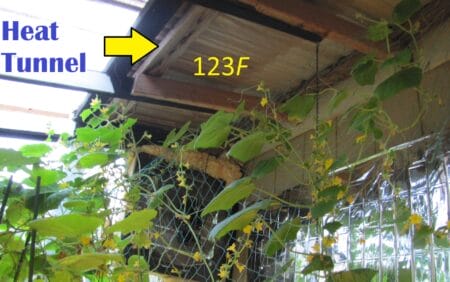
Still that happened before I had gotten around to putting proper insulation on the part of the roofline that hung around 24 inches into the room. This week – because I am semi-retiring for the ninth time now, that “heat tunnel” got covered up. And this is where our story begins.
Seems like the average size of these space blankets is about 84 inches one way and 52 inches the other. I ordered a 20 pack and it was less than $20.
Heat Tunnel School, II
The heat tunnel (open rafters) is where a piece of bare metal roofing hangs out over the house side. Of course, inside over the music studio, there is plenty of insulation. But out here – since the insulation didn’t extend out – those metal undersides would radiate at up to 130F on a 97F ambient day.
I got out my dog-eared copy of Glover’s RefDesk (no redneck engineer can be without it) and I learned only enough to be dangerous before confronting my AI stack. Both Grok and ChatGPT agreed on one simple thing. The biggest bang for the insulation effort would be space blankets. Almost 30 SF per so with 20 in a pack you’re sneaking up on 600 SF of insulation for $20. You can’t beat that with a stick.
BUT There is Fine Print
I don’t claim to understand all I know about insulation. But there is general thermal and there is radiative. Radiative is the enemy here. I have a couple of 4 foot wide (x 25F) rolls of closed-cell foam. But all the modeling said the biggest heat reduction would come from “shiny side up” Mylar aimed back at the sheet metal and sealed around a bit.
With no change in the swamp cooler, that knocked almost 5-degrees off previous room heat gain. And that was just focusing on the highest heat gain areas closest to the cooled air equipment.
Now the fine print: Working with Mylar can be a 24 kt bitch. I was planning to put my electric staple gun in the slam and jam mode. But, turns out, when you do that, Mylar has this ugly tendency to tear.
Then the answer appeared! A 2″ square hunk of solid gaffer tape. By god that was the end of Ure’s Mylar-shredding nightmares on the spot.
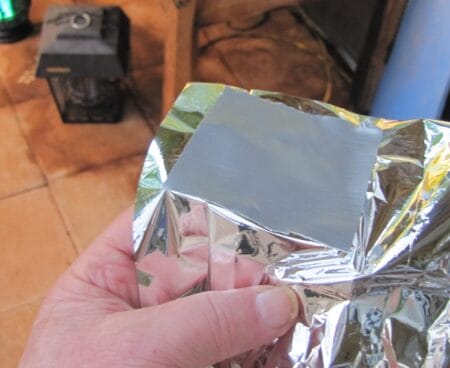
The gaffer tape spreads out the load on the film and is never rips. The gaffer tape with a single staple in won’t quite lift a lawnmower, but it’s impossible to get down under all but world-ending conditions.
And so our “Box to Cobble Emergency Housing” now has a hundred Mylar emergency blankets, several miles of gaffer tape, and plenty of stainless staples. I know it sounds silly, but it was one of those dee-lightful moments when going lower – not higher – tech actually made the most sense.
Meanwhile, Back in the Greenhouse
Friday lunch was centered around this:

A nearly perfect tomato. Which, when served with chips, fresh salsa (store bought), canned salmon in olive oil, some sliced provolone. and a hunk of beef jerky, it wasn’t a half bad lunch.
Cooler is better for growing once root mass gets over 78 F, or so, and foliage (ask me how I know this) will drop flowers at 100 F and above. And the Mylar on the walls ensures none of your grow light power bill gets wasted.
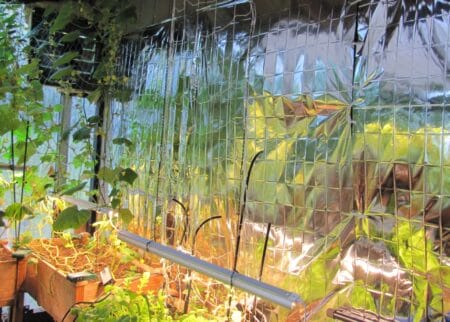
But the incremental changes are having an impact.
Air Speed and Media Thickness
I also (Saturday) swapped out the Chinese made swamp cooler for another big Hessaire. A lot more money, but this is one of the casts where slick marketing doesn’t pay off.
The Asian product had a slightly smaller water tank and a much smaller (overhead view) foot print. Turns out – after working the science on this – that Asian chiller only really “got down to cold” when it was on speed 1. But when it went up on speed 2, the airflow output warmed.
Turns out their cooling is proportionate to the airspeed and time inside the media. The Asian unit had smaller pads dimensionally, but the big deal was they are only half as thick as the Hessaire (roughly, I didn’t mike it out).
But you can’t beat physics, doesn’t matter which country of origin.
All worth it. But if you don’t believe me, taste a tomato 10-minutes off the vine and one that’s ridden the rails across the country – you’ll see why we do the hot work.
Two Short “Farmer Stories”
The first one is funny.
So, there I was, mowing the lawn last week, and I noticed that the cut on the 54″ riding mower was scalping the left side.
After washing the rig off and thinking about what it might be, I started with the obvious. Namely, check the left side tires for air.
Sure enough, left rear had a slow leak and so out came the portable inflator – it held all but a half pound for a day and that was that.
Not much of a story, so far, right?
Here’s the learning moment: While I was checking the tires all around, I couldn’t find the valve stem on the right rear. What’s more, one lug bolt was missing.
Turns out when the tractor was new and being assembled (bought it at Lowe’s a few years back) they had put the wheel on outside-in.
I know “Why didn’t I catch that before?” Old men and their preoccupations, I guess.
Second story has a point, too:
Out at the welding table this week, I noticed there was a bunch of fresh sawdust around. “What the hell?” right?
Only took a minute to find it: 2 by 8 beam overhead, a carpenter ant colony had moved in from the forest. Quickly dispatched with poison.
But a worth-mentioning: If you see “mystery sawdust” showing up around your home, those are termites or carpenter ants, so best be getting after it.
Back to chilling the greenhouse – rebuilding an old Hessaire from years back – so we can run two of them in tandem on low…
Write when the sweat lodge closes for the season, ya’at’eeh.
George@Ure,net
Consider subscribing to our deeper work.
Read the full article here