





This, boys and girls, lads and lassies, is what you call a “Dregs of Summer” column. Market news is thin, polarization among the people is high, and the summer is approaching Hell’s HVAC settings.
What’s a “Face Rally?”
Monday. That’s the template. Monday’s close was 51,839.26, down 307.16; 52,411.90 was the intraday high. The face-plant-close, down 307 for the day, was especially interesting. With no obvious news — except odds on next week’s Fed meeting — we think. And eye beer. After all, it’s hot out.
Conclusion? We sense that “painted markets” are in play.
For small traders, every twitch and jigger can kill. Higher up — at the intergenerational 300-families level — time is managed differently. Months, not days. That’s the essence of power: toss an ingredient into the stew, then watch it simmer while everyone else argues over the bubbles.
The market Monday displayed “good face” trading. But by the close, it had turned ugly. We still have that chance of a blow-off top into Labor Day, however the fall looks like just that: a major fall.
Watching the Waveforms
People who have relied on oscilloscopes for much of their lives have an easier time of it than non-electronics-oriented people.
After some years, a good tech’s visual cortex begins to recognize recurrent themes in waveforms just before the smoke lets loose. Crypto knights are screaming that rising above $66,000 means the return to green is a “safe” bet. (They drop the word bet as their belief system demands.)
Now I want you to look at that vertical dashed line. Then look not at the asset numbers, just the waveform of our Aggregate Index. In your mind’s eye, place it so the right side of the chart below sits just to the left of the dashed line above.

It’s a very simple example of how my friend, The Economic Fractalist works on cracking markets. You can learn more by reading his site over here: The Economic Fractalist | Non-Stochastic Saturation Macroeconomics.
Flag and Pennant School
To make this clear, I’m going to zoom even closer-in on the Aggregate and draw the possible pennant for you.
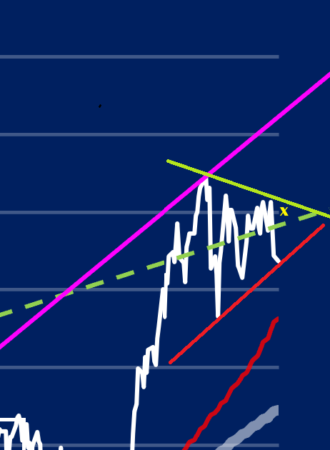
I hate waveforms like this. The top pink is the “trend channel top” the market has drawn itself. The green sloping top of the “flag” is the line above which a further rally may appear. The straight red line is when you load the loved ones in a lifeboat and pray.
The tiny yellow “x” is where the early futures point.
The Key Learning Point
Here’s our “listen up” part:
Flags and pennants are the market’s little “catch-your-breath” patterns. They usually show up after a sharp move — the flagpole — when price pauses, chops sideways or slightly against the prior move, and lets the latecomers decide whether they still want in. A flag usually looks like a small tilted channel, often slanting opposite the prior move. A pennant is tighter and more triangular, with price compressing into a small wedge. In both cases, the theory is the same: after a fast run, the market consolidates before trying to continue in the original direction.
You can see how BTC resolved with a final burst higher in October 2025. Then it was over. Equity markets may yet bring a final manic blow-off on “false peace” or “breakthrough.” We get to wait.
The key is that the pattern is supposed to be a continuation formation, not a stand-alone prophecy. A bullish flag after a strong rally means buyers are resting, not necessarily quitting. A bearish flag after a hard decline means sellers may be reloading. Traders generally look for declining volume during the pause and then a pickup in volume when price breaks out of the flag or pennant. The breakout direction matters; until price actually breaks, the pattern is only a candidate, not a verdict.
The failure mode is worth respecting. In noisy modern markets, every pause gets labeled a flag by someone with a chart and a need to talk. A real flag or pennant should be brief relative to the preceding move, proportionate in size, and clean enough that the eye does not have to invent it. If the consolidation drags on too long, widens, or breaks the wrong way, the market is no longer “resting” — it is repricing. Good traders use flags and pennants as context, not religion: they mark the likely continuation path, then let price confirmation, volume, and risk control decide whether the pattern deserves money.
And that’s how the market “puts on a good face” while underneath, the 300 family wealth is heading for safer ground. Feel better now?
News Compressor: ON
The main thing that changed overnight is continued escalation in the US-Iran conflict alongside domestic US political and weather developments.
US forces conducted their 10th consecutive night of strikes on Iranian military targets, following an Iranian attack that killed two US service members (ages 19 and 25, from Texas and Hawaii) in Jordan, with one initially missing. Casualty figures from Iranian strikes since early July have risen, with the Pentagon accused of withholding details on dozens of injuries. Tanker traffic through the Strait of Hormuz remained limited (around 4 vessels on recent days), though some transits continue amid risks; oil briefly topped $90–$91 before easing.
Underreported: Incremental US military injury tallies and withheld details (65%).
Domestically, President Trump imposed 50% tariffs on certain Canadian goods (autos, alcohol, dairy) over alleged trade discrimination.
Tropical Storm Bertha strengthened in the northeastern Gulf, bringing flash flood and storm surge risks to the northern Gulf Coast (Florida Panhandle to Louisiana). No major new US domestic mass-casualty disasters reported in the mandatory sweep, though ongoing wildfire and flood recovery contexts persist from prior periods.
News Forecast
12–96 Hour Outlook
- Tropical Storm Bertha impacts (next 24–72 hours): Heavy rainfall (2–4+ inches, isolated higher), tropical storm conditions, and surge along Gulf Coast from FL/AL to LA. Slow movement increases flood risk; monitor NHC for track shifts toward TX. Matters for East Texas preparedness.
- US-Iran strikes/diplomacy (ongoing/12–96 hours): Potential further exchanges or pauses as delegations eye Qatar talks; Houthis announce Saudi blockade, widening energy risks. US consequences include casualties, oil volatility, and supply chain effects.
- Tariff effects (immediate–96 hours): Canadian retaliation risks and higher costs for affected goods; markets watching for escalation. Canadian Prime Minister Mark Carney continued negotiations. Importers need the covered tariff lines and implementation date, not the political headline. Exemptions, postponement or a negotiated package remain possible. Confidence that businesses face near-term pricing uncertainty: 87%.
- Markets/earnings (24–72 hours): Futures modestly higher amid earnings; oil volatility persists. Geopolitics and Fed signals key.
- Ukraine/Russia (ongoing): Large Russian strikes reported; drone activity. Limited direct US impact but energy/food ripple effects.
- UK politics (immediate): Andy Burnham as new PM; stability and tax signals.
Odds of a Fed rate hike now up to 16.6 percent. Worry only today, but may grow and get contagious late week.
Around the Ranch: Mail Crap Dance
We – the voters in America who are nominally in charge of our own government – have a big decision to make. Do we reward falling performance?
Since last week, I have been telling you the daily adventures of Elaine’s gift – an Army green IBM Selectric II – like the one she ran in the military as an MCST specialist. Read this bottom to top and you’ll see why we don’t think USPS deserves a raise:
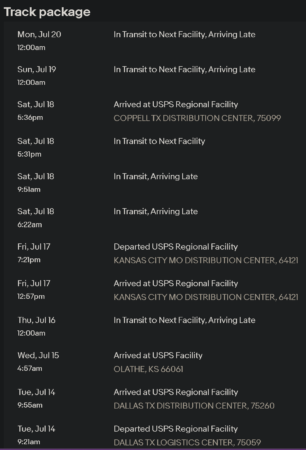
I kept this short for you – it was actually mailed in Colorado on July 7th. I just checked a few minutes ago, and in the last hour, we can see how USPS is rewriting computer history to cover-up its misrouting errors.
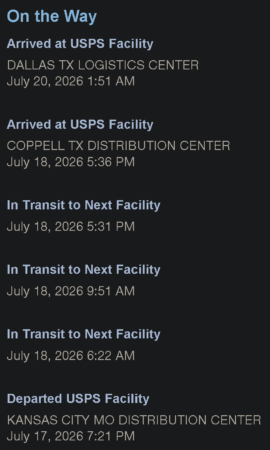
Two days to get 20 miles? Can’t rush things, naturally.
Now, I’m not saying that postal workers, en masse, shouldn’t get a raise. But we all need to keep our wits about us when talking money.
The Modern Money Game – A Short Course
Here’s how we think of raises.
- Begin with the wage you made one year ago.
- Adjust it up or down, depending on the whole Consumer Price Index, year-on-year.
This is NOT a raise. It’s recognition that our money is crooked and depreciates all the time. It’s the government con to make it all look like growth.
It is not.
I don’t mind workers being kept at current cost realities. What I do mind is “performance bonuses”. USPS disclosed at least $2.49 million in executive bonuses and related payments during calendar years 2023 and 2024. The actual organization-wide incentive-pay total was higher but is not separately disclosed.
For literal calendar 2024–2025, the CY2025 statutory executive table has not yet been published as of July 2026.
Like our missing Selectric – which seems to joy-ride out of the Dallas area – maybe USPS could stamp out inefficiency and consultants. Let carriers run the show. Think Employee-Owned.
Works for Publix – which has 250,000 workers in its ESOP. Or just let Amazon buy it since they keep it alive, anyway.
That’s Our BFdJ (Brain Fart du Jour)
Miss it?
The data screams Amazon should set eBay up as a merchant through an affiliate program (or just buy eBay outright). Because (magically) Amazon packages get here in a day or two. I hear they don’t take crap when stuff runs late.
eBay via USPS? That’s more like going to Vegas, or Kansas City…
Write when you get rich,
Consider subscribing to our deeper work.
Read the full article here