





What Time is It?
That’s one of the foundational questions we get into on the Peoplenomics side of the house ($40/yr), along with “getting the most” out of whatever system we’re all presently swimming in.
So – if you’re wondering “Where’s the gain from the Iran War, and what does “win” look like in Ukraine?” pay attention. The gears of history are turning.
Liberals Move at Economic Peaks
Broadly, we might generalize that socialism and third parties in corporate-owned duopology states, seem to rise at economic peaks. That’s why, socialist-lite Franklin Roosevelt had such a long run. His unprecedented run eventually produced presidential term limits after his death.
Moodwise? We’ve been here before – as a country – in the Great Depression window. The “pre-rise” part of socialism in America was not just shown by Bernie Sanders, who we class as Roosevelt-like, but also in recent election returns. Leaving us to wonder what an actual definition of constitutional socialism might look like. Regardless, it’s a replay.
Let’s drive a temporal survey stake into 1924: Robert M. La Follette’s Progressive Party.
- Late 1920s: The Progressive surge of 1924 was fueled by farm distress, labor discontent, and reaction against conservative Republican dominance under Coolidge. The formal Progressive Party of 1924 faded after the election (its national committee last met in 1927), though progressive/Farmer-Labor currents continued at the state level (especially Wisconsin and Minnesota).
- Great Depression years (early–mid 1930s): Dissatisfaction was intense, and left-wing third-party or independent activity grew. Norman Thomas (Socialist) rose to about 2.2% in 1932. Huey Long’s Share Our Wealth movement claimed millions of members by 1935 and was widely viewed as a serious potential third-party threat to FDR; Long was assassinated that year before he could run. The residual Union Party (William Lemke in 1936, drawing on Long/Coughlin/Townsend forces) managed only about 2% nationally and quickly collapsed.
We’re not saying this will or even could happen in America. But, some bright and thoughtful people are starting to ask questions. Tucker Carlson unveils 10-point manifesto amid third-party speculation.
Third Party Planks
Carlson, as happens, is onto something. We yoked up the AI team this morning and plowed through data to find 10 things the present corporate duopoly has gotten wrong. Failure to deliver, specifically. It’s an interesting list:
- National debt and fiscal prioritization — Both parties have driven sustained high deficits and rising debt-to-GDP under unified and divided government. A workable plank: statutory pay-as-you-go rules with automatic triggers, multi-year spending caps by category, and mandatory public scorekeeping of long-term liabilities before any major bill advances.
- Healthcare cost containment without single-payer ideology — Affordability ranks among the top national problems across parties. Both sides have expanded coverage or subsidies while costs continue rising for many. Plank: aggressive price transparency, interstate insurance competition, site-neutral payments, targeted drug-price negotiation for high-cost therapies, and expanded Health Savings Accounts paired with catastrophic coverage.
- Immigration enforcement + legal pathways — Polarized extremes (open borders rhetoric vs. maximal restriction) have left a functional vacuum. Public majorities support both secure borders and orderly legal immigration. Plank: mandatory E-Verify, physical and technological border control, expanded employment-based visas tied to labor-market data, and a limited earned path for long-term non-criminal residents who pay back taxes and penalties.
- Money in politics and structural reform — Large majorities across parties see the role of money as a very big problem. Neither party has delivered meaningful limits while in power. Plank: real-time full disclosure of all contributions and dark-money vehicles, contribution limits that actually bind, congressional term limits (e.g., 12 years House/18 Senate), and stricter revolving-door rules.
- K-12 education outcomes over bureaucracy — Federal involvement has grown while reading/math proficiency and civic knowledge have stagnated or declined for many cohorts. Plank: expand portable education savings accounts/vouchers, devolve curriculum and accountability to states/localities, end federal mandates that prioritize process over measured results, and restore basic skills and civics as non-negotiable floors.
- Energy abundance and reliability — Both parties oscillate between climate absolutism and fossil-fuel absolutism, producing permitting delays, reliability risks, and higher costs. Plank: all-of-the-above permitting reform (nuclear, natural gas, renewables, transmission), accelerated licensing for advanced reactors, and market-driven reliability standards rather than pure subsidy or pure prohibition approaches.
- Criminal justice that prioritizes public safety and proportionality — Crime and disorder concerns remain high for large shares of the public even as national trends fluctuate. Both parties have swung between soft and hard extremes. Plank: fully fund and support local policing for violent crime, targeted reforms for non-violent/low-level offenses, faster adjudication, and data-driven diversion that does not reduce consequences for repeat violent offenders.
- Foreign policy restraint and prioritization — Endless commitments and unclear end-states have eroded public trust under administrations of both parties. Plank: explicit sunset clauses or reauthorization votes for major military engagements, alliance burden-sharing requirements, and a default preference for economic and technological competition over open-ended military presence unless vital interests are directly threatened.
- Free speech and institutional neutrality — Government pressure on platforms, campus and corporate speech codes, and selective enforcement have created a chilling effect noted across ideological lines. Plank: statutory bars on viewpoint-based government jawboning of private platforms, viewpoint-neutral enforcement of public accommodations and employment law, and protection of academic and scientific inquiry from political litmus tests.
- Cost-of-living and regulatory accumulation — Housing, energy, food, and childcare costs dominate household concerns. Both parties add rules while rarely sunsetting old ones. Plank: one-in-two-out regulatory budgeting at the federal level, accelerated housing permitting on federal and local lands, and targeted antitrust enforcement focused on actual consumer harm rather than size alone.
The COD (Corporate-Owned Duopoly) will of course claim (very profitable to them) reasons why we’ve had no substantive deliverable show up. But there’s a reason: financializations like slow-speed shifts, harvestable revenues, and high-level control. And notice how “Open Borders” and conflict refugees were managed to levels suspiciously like HR office targets?
We live under that corporate detent paradigm in spades, right now.
Long-time reader LOOB (if my memory isn’t failing me) said words (*to the effect, exact quotes are dangerous without more coffee) “Makes it easy to run on the same issues – time after time…”
This is why the Innovator and Deep-Thinker class of reader hangs around here. For the odd glance at historical time – to set our temporal clocks “all along the watchtower, the hour’s getting late…“
“there must be some way out of here,
said the Joker to the Thief…“
Job Chops and Data Shops
Challenger numbers this:
“JULY LAYOFFS PLUNGE TO 33,429, HIRING PLANS TICK UP; AI LEADS REASONS FOR FIFTH CONSECUTIVE MONTH
It is down 46% from the 62,075 layoff plans announced in the same month last year, and marks the lowest monthly total in two years, according to a report released Thursday from global outplacement and executive coaching firm Challenger, Gray & Christmas.
July’s total is the lowest monthly total since July 2024, when 25,885 cuts were announced. Through July, employers have announced 477,033 job cuts, down 41% from the 806,383 cuts announced in the first seven months of 2025. It is the fifth time this year cuts are lower than the corresponding month one year earlier.”
Down at the Unemployment Offices, it looks like this now:
This means, for now, the corporate duopoly is safe – and that rabble-rousing talk will statistically remain muted until the bubbles are pricked. Eventually, AI overbuild and military adventurism will run their course. Just not before lunch today.
News Compressor: ON
The Vital Four (What to expect at the watercooler talk…)
1. “Peace” may mean an Iranian tollbooth at Hormuz. The proposed Iran–Oman arrangement would reopen the Strait of Hormuz but reportedly give Tehran authority over inbound Gulf shipping—and possibly outbound traffic as well. Iran is seeking fees equal to roughly 5–7% of cargo value, while Oman has discussed about 3% and Washington wants no fees. That is not a return to the prewar status quo; it would formally monetize Iranian control of the world’s most important energy passage. Large issues remain unresolved, so Trump’s suggestion that agreement is imminent looks ahead of the negotiating text. Tell us again: How much did this cost us?
2. The market has split in two. At about 6:07 a.m. Central, DIA was up roughly 0.44%, while SPY was down 0.23% and QQQ was down nearly 0.95%. Nasdaq futures were being pulled lower by semiconductors, including SanDisk, Western Digital, Micron and AMD, even as Dow-type shares benefited from Hormuz optimism. Brent was near $79.54 and WTI about $75.27. Translation: the “war premium” is easing faster than the “AI premium,” and investors have begun questioning whether every technology earnings story deserves another lap around the track. As we explained in Peoplenomics, since the blow higher, this is a normal pause – higher remains possible until the paradigm cracks and pre-Labor Day mood swings are presently supportive of higher…
3. The socialist-progressive surge has become an operating political force—not merely a protest mood. Abdul El-Sayed defeated the Democratic establishment’s candidate in Michigan’s Senate primary despite being heavily outspent, becoming the first progressive to win a statewide primary in a state Trump carried in 2024. Reuters also documents a rapidly expanding left-wing ecosystem of podcasts, livestreams and independent outlets now doing for progressive candidates what talk radio and alternative media previously did for the right. For the third-party question, the immediate signal is that insurgents are still finding it easier to capture a major-party nomination than build a new national party. Which is why this morning’s historical/cyclical deep-dive…
4. Spokane’s fire disaster is stabilizing—but not over. Cooler conditions helped firefighters establish lines around three major fires, yet approximately 67,000 people remained evacuated and about 850 buildings had reportedly been destroyed. Hotter, drier and windier weather is expected to return. The broader Western pattern remains dangerous: intensifying heat, Northern Plains fire weather and persistent Northwest air-quality problems.
Inside Pages
The “vital four” are the only pop-ups for water cooler talk. You’ll need these, too:
1. Americans are souring sharply on the Iran war. Only 35% approve, while 50% expect the war to destabilize the Middle East over the coming year; just 17% expect greater stability. Fifty-eight percent expect gasoline prices to worsen. That polling pressure helps explain the administration’s sudden enthusiasm for declaring negotiations successful.
2. Israel and Lebanon are flaring during negotiations. Two Israeli soldiers were killed in southern Lebanon; Lebanese authorities said Israeli retaliation killed at least one person. The violence coincided with U.S.-brokered security talks in Rome.
3. The Black Sea is becoming a second global commodity choke point. Attacks on ports, tankers and export terminals are disrupting Ukrainian grain and Russian oil movements, lifting insurance and freight costs. Got a garden and food inflation hedges set for fall?
4. Overnight Russian attacks killed six Ukrainians.
5. Russia’s drone industry is being attacked at the human layer. A bomb beneath a Mercedes wounded Uraldronzavod chief Vladimir Tkachuk and killed his driver. It was the second attack on a Russian drone developer within a week, suggesting that designers and production managers have become strategic targets alongside factories.
6. Congo has moved to keep more critical-mineral processing at home. The government immediately banned exports of copper and cobalt concentrates, with limited strategic waivers possible. That is a meaningful upstream warning for batteries, electronics, grid equipment and defense production: mineral-rich countries increasingly want processing jobs and margins, not merely royalty checks. China’s interest in Africa is likely to collide with Western dependence.
7. Washington has refunded about $100 billion in invalidated tariffs. The money represents more than half of the $166 billion collected under duties the Supreme Court struck down. Besides the Treasury cash-flow impact, it exposes the enormous economic cost of governing trade by executive improvisation and sorting legality out afterward.
8. Justice Department misconduct complaints have reached a 20-year high while investigations reached a 20-year low. Which part of “surprised…”
9. Paid-family-leave policy is arriving through tax incentives rather than a mandate. New Treasury guidance will allow employers to claim credits for paying leave-insurance premiums. Corps get the dough while workers get the show? WTF?
10. Marine One and a passenger jet briefly lost required separation. Both aircraft landed safely and Trump was reportedly not endangered, but the FAA is reviewing why an Envoy Air flight was permitted to depart Reagan National while Marine One was nearby. Pilots (like me) holding SiFRA certs are reminded to refresh on Reduced Vertical Separation Minimum (RVSM) | Federal Aviation Administration,
Related, sort of: The Marine Corps lost another F-35B, but the pilot survived. The aircraft crashed near Miramar after apparently losing control during a low-altitude maneuver; the pilot ejected and was hospitalized in stable condition. The aircraft was destroyed, making it a Class A mishap. (RVSM to ground?)
11. Out here: East Texas gets another greenhouse-management day. Palestine was 76°F this morning, heading toward about 97°F, with similar highs Friday and Saturday and roughly 98°F Sunday. With the humidity, it will feel closer to 105°F.
BYOPC (Bring your own pit check.)
Day Planning (The Important Stuff)
Hydrate.
Our AI stack suggests you clip and save this: Approximate cooling times for a standard 12 oz aluminum can of beer in a good household freezer (set to ~0°F / –18°C with reasonable airflow).
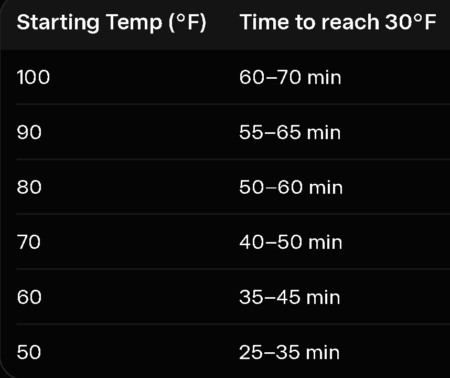
The “approved” UrbanSurvival beer is served close enough to freezing (with the beer forming some crystals in a suitably frozen container) that ice clumps are seen.
Advance Studies Group: A 3.2% (panther piss) beer will start freezing sooner (and more easily) in a freezer or cold car than a 5% beer. Always monitor closely when chilling either near or below 30°F. Consume all samples immediately on completion of measurement.
Tomorrow we get the federal jobs report. We think it won’t be bad and in the absence of that, the blow-off higher might continue. With the detailed perspective on Peoplenomics Saturday morning.
Around the Ranch: Doing Debby
Elaine and I were off on another one of our “Old People doing Medical Adventures” rounds Thursday. Elaine has a (benign) fatty cyst on her upper right arm that has been there for at least 10 years.
Back to point: Our Medical Assistant’s name is Debby. As usual I began with “So, do you do Dallas?”
Elaine rolled her eyes, catching my ref to the 1978 (soft) porn flick Debbie Does Dallas – Wikipedia.
“You’re the 16th one so far this month,” she informed me – “And it isn’t even lunch yet and only the third working day of the month…” Ouch!
So, your assignment is to confirm (with all the Debby’s you know in Texas) whether this observational data is valid.
Write when you get rich, or the ice crystals are forming at pour,
PS Our AI proofreaders offered this today: “Serious political-cycle analysis up front; practical civilization-saving data near the bottom. That is very UrbanSurvival.” Yeah. Ain’t it, though?
Consider subscribing to our deeper work.
Read the full article here