


Key Takeaways
- The 10th Circuit ruled that Colorado’s ban on unserialized firearms implicates the Second Amendment, sending the case back to the district court.
- Plaintiffs challenged Colorado Senate Bill 23-279, arguing it criminalizes lawful possession and manufacture of firearms parts.
- The court emphasized that firearm possession regulations apply beyond commercial transactions, impacting private transfers as well.
- Colorado must now justify SB 23-279 under the Bruen historical analogy test, complicating its legal defense.
- The ruling is significant for gun owners, as it affirms their rights to modify and possess firearms parts without onerous restrictions.
Estimated reading time: 8 minutes
DENVER, CO — The U.S. Court of Appeals for the 10th Circuit has ruled that Colorado’s ban on possessing unserialized firearms and firearm parts directly implicates the Second Amendment, sending a high-profile gun rights case back to the district court for further analysis under the modern Bruen framework.
The 2-1 decision in National Association for Gun Rights v. Polis was issued on April 23, 2026. The ruling reverses key portions of a lower court decision that had denied gun rights plaintiffs a preliminary injunction against Colorado Senate Bill 23-279, the state’s so-called ghost gun law signed by Governor Jared Polis in June 2023.
The Plaintiffs and the Law
The case was brought by three individual plaintiffs, Christopher Richardson, John Howard, and Max Schlosser, along with two organizational plaintiffs, the National Association for Gun Rights and Rocky Mountain Gun Owners. They sued Colorado in January 2024.
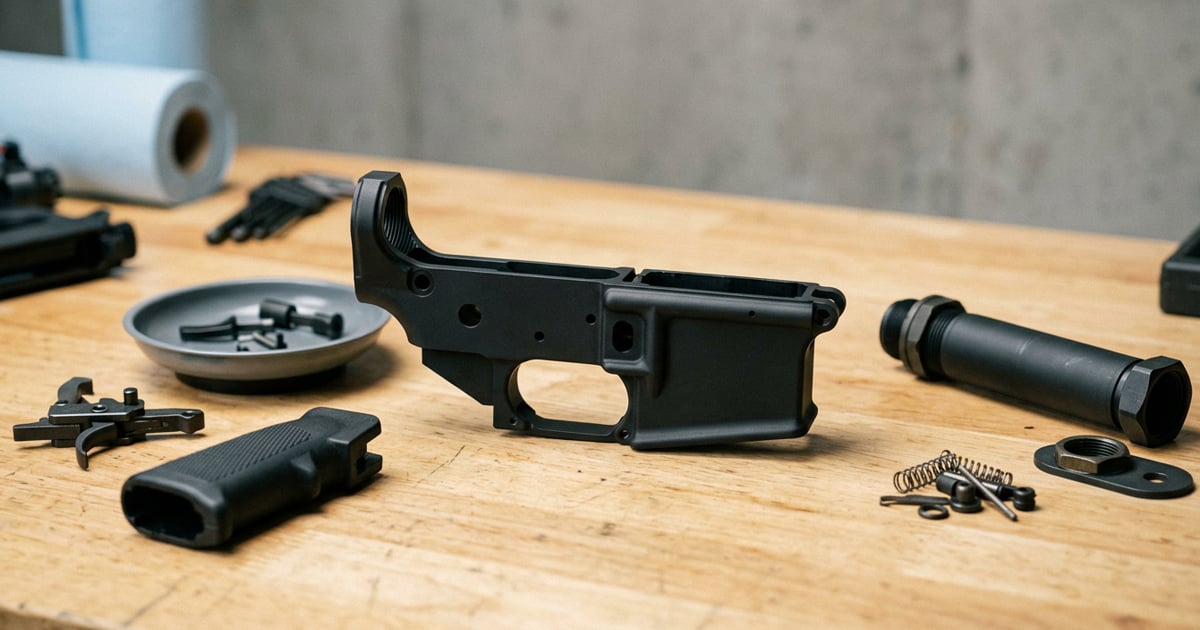
Colorado SB 23-279 prohibits the purchase, sale, transfer, and possession of unserialized firearms, firearm frames or receivers, and firearm parts kits. It also bans the 3D printing of frames and receivers without a license. Multiple violations are felony offenses. The law contains an exception when an owner obtains a serial number from a licensed firearm dealer who performs a background check.
U.S. District Judge Gordon Gallagher, a Biden appointee, denied the plaintiffs’ motion for a preliminary injunction in May 2024. The plaintiffs appealed.
What the 10th Circuit Actually Held
The three-judge panel issued a mixed decision. Judge Joel M. Carson wrote the majority opinion, joined by Judge Allison H. Eid. Both are Trump appointees. Senior Judge Paul J. Kelly Jr., a George H.W. Bush appointee, wrote a separate partial dissent.
On the manufacturing ban, the panel ruled against the plaintiffs on standing grounds. The court interpreted the Colorado statute to apply only to 3D printing of frames and receivers, not to assembling firearms from parts kits. Because the plaintiffs said they intended to build firearms from kits rather than print them, the panel held the manufacturing ban did not actually prohibit their intended conduct.
The bigger ruling came on the possession ban. The district court had dismissed the plaintiffs’ challenge by treating the possession prohibition as a “condition or qualification on the commercial sale of firearms,” a category that the Supreme Court’s Heller decision identified as presumptively lawful.
The 10th Circuit rejected that framing.
The court wrote that “Although Plaintiff Richardson purchased his firearm parts kit from a commercial seller, he would risk violating C.R.S. § 18-12-111.5(1)(a) even if he had received this firearm parts kit as a gift from a friend. This provision has nothing to do with the commercial nature of the prior transaction. Because a regulation of firearm possession is not a condition or qualification on the commercial sale of firearms, the district court abused its discretion in denying Plaintiffs’ motion for a preliminary injunction on this basis.”
In plain English, owning a part you got as a gift, inheritance, or any non-commercial transfer has nothing to do with commercial sales, so the law’s reach extends well beyond the narrow exception the lower court tried to apply. That brings the possession ban squarely within the Second Amendment’s plain text.
The panel also reversed on the purchasing prohibition. The plaintiffs alleged they wanted to continue purchasing firearm parts kits, including from private individuals. The district court had dismissed that challenge as not ripe. The 10th Circuit disagreed, finding the plaintiffs had standing to challenge the law’s reach into private transfers.
The case now returns to the district court for further analysis under the historical analogue test from New York State Rifle and Pistol Association v. Bruen. Colorado will have to justify SB 23-279 by pointing to a historical tradition of similar regulation from the founding era.
What This Ruling Does Not Do
It is worth being precise about what the 10th Circuit did and did not decide. The court did not rule Colorado’s ghost gun law unconstitutional. It did not strike down any portion of SB 23-279. What it did rule is that the Second Amendment’s plain text is implicated, which is a threshold question that determines whether the state has to justify the law at all.
For Colorado, that is a meaningful setback. Under the Bruen framework, once the Second Amendment’s plain text covers the conduct at issue, the burden shifts to the state to show that the regulation is consistent with the nation’s historical tradition of firearms regulation. There is no clear historical analogue for serialization requirements on privately made firearms before the modern era, which puts Colorado in a difficult position on remand.
Casper attorney Ryan Semerad told Cowboy State Daily that the practical effect for citizens is significant. If charges are brought against someone in connection to firearms parts, they could now possibly challenge the case based on their Second Amendment rights. Prosecutors can no longer argue that such cases have nothing to do with the Second Amendment.
Why This Matters for Gun Owners
The Second Amendment is a fundamental civil right, and the right to keep and bear arms has always included the ability of law-abiding citizens to acquire, own, and modify their firearms.
Building or customizing your own firearms is not a fringe hobby. It is one of the oldest American firearms traditions, predating the founding of the country. The right to manufacture firearms privately is part of that tradition. The federal government has never required private individuals to serialize firearms made for personal use, and the ATF’s own regulations explicitly exempt private individuals from marking requirements when they make a firearm for personal use or occasionally sell or transfer one.
Modern AR-15 and bolt-action rifle building is essentially modular firearm ownership. A serialized lower receiver, purchased through a licensed dealer with a background check, is the regulated piece. Beyond that, owners can configure barrels, stocks, sights, and accessories to match their use case. One serialized lower can host multiple upper receivers chambered in different cartridges, effectively giving an owner several rifles in one.
State-level bans on the possession of unserialized parts criminalize ordinary, lawful conduct that millions of Americans engage in every day. The 10th Circuit’s ruling pushes back on the idea that states can simply categorize firearms parts out of the Second Amendment by labeling them as commercial regulations.
More from USA Carry:
Context: The Federal Picture
The Colorado case is unfolding alongside a parallel federal fight over the ATF’s 2022 Frame and Receiver Rule. That rule, finalized under the Biden administration, expanded the federal definition of “firearm” to include unfinished frames, receivers, and certain parts kits.
In Bondi v. VanDerStok, decided in March 2025, the Supreme Court ruled 7-2 that the ATF’s federal rule was not facially inconsistent with the Gun Control Act. Justice Neil Gorsuch wrote the majority opinion. Justices Clarence Thomas and Samuel Alito dissented. The Court’s ruling was narrow and preserved as-applied challenges, sending those cases back for further proceedings.
On April 27, 2026, the Second Amendment Foundation and Defense Distributed filed a motion for summary judgment in Defense Distributed v. Blanche, the renamed continuation of the federal challenge. That motion presses constitutional rather than statutory arguments against the federal rule.
I. have also reported on the ATF’s recently announced 34-rule reform package under Executive Order 14206, Protecting Second Amendment Rights. The agency’s frames and receivers regulation has been a moving target in 2026, with the Department of Justice initially signaling a rewrite, then signaling retention of the existing rule, then signaling rewrite again.
For Wyoming and other Western state gun owners, the 10th Circuit ruling has direct practical implications. The 10th Circuit’s jurisdiction covers Colorado, Kansas, New Mexico, Oklahoma, Utah, Wyoming, and parts of Yellowstone National Park in Idaho and Montana. The reasoning the court applied to Colorado’s law would apply equally to similar legislation in any of those states.
Modular firearm building has grown from a niche pursuit into a mainstream activity. The combination of accessible parts, online resources, and improved manufacturing has made it possible for ordinary gun owners to assemble custom rifles and pistols at reasonable cost. State laws that criminalize possession of common parts threaten that entire ecosystem.
What Comes Next
The case returns to U.S. District Judge Gordon Gallagher for further proceedings on the possession and acquisition challenges, this time with the threshold Second Amendment analysis settled by the 10th Circuit. Colorado will need to come forward with historical analogues to defend the law under Bruen.
The plaintiffs may seek a renewed preliminary injunction at the district court. Whatever the district court decides on remand will likely be appealed again, and the case could ultimately reach the Supreme Court.
I will continue tracking the case through the next phase of litigation.
The full text of the 10th Circuit opinion in National Association for Gun Rights v. Polis, Case No. 24-1209, is available at the 10th Circuit’s website.
Read the full article here