





Breaking: NFIB Optimism
Just out:
The NFIB Small Business Optimism Index fell 0.5 points in February to 98.8 but remained slightly above the 52-year average of 98. The Uncertainty Index decreased three points from January to 88.
- The Employment Index ticked up nearly a point in February to 103.5, 3.5 points above its historical average of 100 and 2.3 points above its 2025 average. This gain was driven primarily by its compensation-related components rather than employee-count related ones.
- Fifteen percent of small business owners cited labor quality as their single most important problem, down 1 point from January and the fourth consecutive monthly decline. The last time labor quality, reported as the top issue, was this low was in April 2020.
- A net 1% of all owners (seasonally adjusted) reported higher nominal sales in the past three months, up 7 points from January.
- The percent reporting actual sales gains are now close to the historical average of a net 0%. The last time actual sales were this high was in May 2022.
More on the NFIB site here. Small Businesses Report Higher Sales and Less Uncertainty – NFIB
A 200 DMA Bounce?
We have to begin with where the Futures showed markets up early today. Up. Bigly, strongly and upply (if that’s a word). In the last couple of hours, a push back down. But Europe and the metals are holding gains (more than 1 percent among Europe’s grownups). To us, this has the smell of Bulls driving prices down before running ’em up later. But, shall see. It’s still very ME/News dependent.
Silver is shimmering on hope. Memories of inflation have driven it up and it’s adjacent to $90. Meanwhile, the price of oil futures has moderated. “World of Milk and Honey?” Maybe not. OK, far from it. But it’s a nice change-up after TEF’s and my 1929 “rollover top” lined up.
Think of today as a possible “It feels so good when you stop beating me” day.
Is the 200 DMA Meaningful?
Yes, probably so. Behavior of “rolling over markets” is usually self-similar. Many market disciplines lay out what could be next in some form, or other.
- There’s a chance that in Elliott wave terms, a big “Wave 1 down” is completing this week.
If that’s the case, early lows Monday may have notched a tradable bottom, From here, there’s potential to retrace (up to) 100 percent of the decline.
In our Aggregate, during the early January peaking, 60,703 was seen. Monday closed at 57889.36. Which pencils out to an all-markets loss of around 4.6 percent.
Ellioticians typically look for Fibonacci bounces. Which would suggest potential downturn resumptions after a rally of 23.6%, 38.2%, 50%, 61.8%, or 78.6% of the decline.
Mathematics And Bacon?
I’ve always checked – but never been “whelmed” (as opposed to overwhelmed) by Fibo sequences. Sure, it’s an easy to conceptualize notion. I mean seriously? What could be easier than watching rabbits screw and counting offspring over time, right? (Not our deal, but hey!)
On the other hand, since market cyclicity is of interest, other systems (like fractals after Mandelbot, et al) and their application layer offspring (TEF’s the Lammert cycle work) also do heavy lifting. As you should have noticed over the past couple of weeks worth of columns.
Another practical math line-up remains elusive. But we’ve got a candidate. That would be a market pricing behavior theory buried in the Binet Equation.
“The Who?” No, that was a music group. Listen up:
The shape of an orbit is often conveniently described in terms of relative distance r as a function of angle ?. For the Binet equation, the orbital shape is instead more concisely described by the reciprocal u=1/r as a function of ?. Define the specific angular momentum as h=L/m where L is the angular momentum and m is the mass. The Binet equation, derived in the next section, gives the force in terms of the function theta


What draws me to Binet is planets and such tend to have semi-elliptical orbits. In my (busy, overloaded) visual cortex, that becomes (in Domain-Walker terms) “prices orbiting around a central price. Made all the more fun because the “[perfect] price everything orbits keeps moving. Enter our recent mentions of The Calculus.
(Whew! I need to put a cold towel on my forehead for a sec. Brain’s overheating early today.)
Back at the Coaster Tower
Now it’s do a group visualization of the market decline since early January as the “first drop” on the roller-coaster ride of prices. Today’s a potential Wave 2 rally (and likely coming drop in a Wave 3 down) pictures like this:

In my VC (visual cortex, not vulture cap fund) this drop’s timing will be delimited by angle of rise which becomes calculable once we see whether today’s rally is based off a bottom OR it’s still got more downside to go.
The “Moving Market Writes“
…and having writ, spells out the future?
Here’s how that pencils out in adjacent headspace. (Using simple Excel as our Mind Amplifier tool.)
- We begin by placing the initial (possible) Wave 1 down into our (experientially derived) Elliott-forward outlook model. Because it sometimes tells the Future. Which potentially could roll this way over the balance of the year:
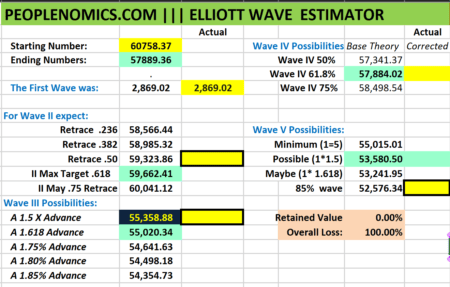
- The problem comes this fall. Because even if (*as this model motions toward) the total decline for the year is ‘only‘ 15 percent, the American public will not stand for it. Result? Control in D.C. will likely shift dramatically this fall.
Of course, that would all depend on Trump making it that far. We continue to get whiffs out in psychic and predictive spaces around the web about coming health problems. But even assuming that’s just noise, a falling economy would change national narrative control.
Hint: This is where we go into ultra-awareness watch for new narratives. Rerun of woke or a pure blame-game roll are leaders down low, for now.
Hopefully, not a Worst-Case
Before we get too carried away with the coaster drop, let’s game out a couple scenarios.
For instance: if we can muddle out of a deeper Iran War, and if China’s Xi isn’t clock-watching on his end of term and wants to reunify Taiwan before leaving… OR, if Putin is up for another year (or three) of war in Ukraine, then a control change in the U.S. would be the meek and mild model.
Bigger concern? We could see a larger, deeper, worse cycle if all the above happens, Trump has a health problem, Vance steps in, China snitches Taiwan AND we get a Depression-Era sized drought as a false flag blows up the big nuke plant in Ukraine and we see Chernobyl II, the sequel drift into Russia?
Modeling that world is straightforward: Scale up the wave structure to one order of magnitude larger.
You just take the “worst case” (wave 5) from the “tame model” above and plug its low endpoint into the same model and recursive magic happens. A MUCH larger Wave 1 down results and look what happens to Wave 5 lows: (This sets our hair on fire.)

After applying a fire extinguisher to my scale, it looks like markets lose just under 40 percent of their value. Of course, with overshoot a decline of 75 percent – maybe more – not the tame 61.6 percent modeled here – comes into view.
Want the Good News?
There ain’t none.
Because when all the waste and crookery worldwide (yeah, in China, in oligarchs, and cartels, too) all begin to blow up, a bad thing rolls. The dynamic in big economic declines is everyone starts looking for a scapegoat (before vaporizing whole cities). That’s because blowing up markets (and pinning blame on opponents) is a logical workflow. Among the monomaniacs in power – not rational people like you or semis like me.
Have a nice day, right?
We do this kind of thinking more often on Peoplenomics. Not out here in front of God and Palantir. On PN, we like to focus on understanding the broken elements in the world.
Which explains tomorrow’s PN: 50-odd pages on how we’re all “Four Track Humans” and we need to focus on our “Noises on Channel 3“. This will make sense after another pot of coffee and a bit more writing.
From My Writing Coach
(Ure’s collaborative AI stack)
My blunt editor read:
The opening market setup works.
The coaster metaphor works.
The Elliott framing works well enough for your readership.
The Binet/orbit material is interesting but interrupts flow.
The worst-case geopolitics section arrives a bit too fast and too hot.
OK, I get that. So let’s slow it down.
Slow People’s News
Different Day, Same Shit (DDSS):
While our wave counts vote on the future: Trump: Iran war will be over “very soon” You expected him to say something else? Who did the line “permanent war for permanent peace”? [Literary note: The phrase is generally traced to Charles A. Beard. Later writers, especially Gore Vidal, helped popularize the modern wording “permanent war for permanent peace. Another example of a liberal “borrowing” concept absent their own…]
Voting today in Mississippi: Here Are the Key Races to Watch in Mississippi and Georgia Elections. Wake me up when it matters.
And Being Right isn’t fun. A year or two back, I told a friend they were nuts for not getting aggressive (*like Elaine and I are) about using all available research on anti-aging to hold back the clock. I was called a nut (and worse). Yet, as time goes on, the data keeps piling up on my side of the argument. Taking A Daily Multivitamin Might Help Slow How Fast You Age. Oh, well. Lead a friend (or horse) to water – and if they bolt, that’s on them.
At the Ranch: Does Weight Change How We Think?
Since I’ve been losing weight, I’ve noticed something that wasn’t on the bathroom scale. I trust you remember, I’ve gone gluten-free and have decided (as part of my drive between the numbers on labs) that getting back in the “thin lane” will increase odds of making 97 from my present age of 77.
A small change in thinking.
Not a lightning bolt. No choir of angels. Nothing dramatic enough to sell as a late-night miracle cure. Just a subtle but persistent shift in mental feel. A little less drag in the corners. A little less bargaining with discomfort. A little more willingness to move from thought into action without quite so much internal committee work. Writing two patents up in a week along with columns and market work – almost an extra energy layer.
And that got me wondering:
Does weight change how people think?
Not in the silly moralizing way pop culture and social frames it. Not “good people are thin” and “bad people are fat.” That’s bumper-sticker pop psychology for people who have never had an honest thought in their lives. (New thoughts are like eggs – hatching them means sitting on them for a minute.)
I mean something more practical.
Does carrying extra weight alter mood regulation? Reward timing? Patience? Irritability? Future orientation? Does it change how much friction a person feels between intention and action? And if it does, then what happens when millions of people go through the same kind of metabolic, financial, and emotional stress at the same time?
Because if individual physiology can bend thought a little, then history suggests shared hardship can bend national thinking a lot.
Which brings us to a question that’s been tapping me on the shoulder from the back of the mental room:
Did people in the 1920s think differently from people in the worst years of the Great Depression?
Of course they did. How could they not?
The 1920s — at least in the popular memory — carried the scent of expansion, motion, novelty, speculation, jazz, speed, credit, and a rising faith that tomorrow would be bigger, shinier, and easier than today. The country had swagger. Risk looked glamorous. Debt could masquerade as optimism. The future seemed like a party that might never close.
Then the music stopped.
And when the Depression sank its teeth in, the national mind changed with it. People who had lived forward began living defensively. Attention narrowed. Time horizons shortened. Luxury became insult. Waste became sin. Security moved from abstraction to obsession. Repair mattered. Saving mattered. Holding on mattered. A whole nation that had been flirting with possibility got dragged into triage.
That is not merely economics. That is a change in collective cognition.
A change in how people measure risk. How they define enough. How quickly they trust. How much uncertainty they can tolerate. How willing they are to gamble, forgive, defer, plan, marry, move, hire, lend, build, or dream.
In other words, the economy doesn’t just hit the wallet. It rewrites the mind.
Which is why this little personal weight-loss observation may be more than just some mahogany foxhole refugee turned nut-job inventor and wannabe rancher noticing his belt has moved in a notch. (*The scale no longer reads “Will one of you please get off?)
It may point toward something larger. If a shift in body state can slightly alter thought in one person, then a shift in national circumstance can alter the operating psychology of millions. And if that’s true, the most important question in front of us may not be whether the country gets poorer.
It may be whether the country thinks poorer.
Because once a nation begins to think in scarcity, fear, grievance, and immediacy, everything downstream changes. Markets change. Politics changes. Families change. Appetite changes. Even morality changes. What was once called prudence can harden into hoarding. What was once called hope can begin to look like recklessness. What was once called charity can begin to feel unaffordable.
That’s the part worth watching.
Not merely whether a hard economy is coming, but whether it will produce the same mental weather patterns that hard times have always produced: shorter horizons, lower trust, faster anger, simpler narratives, and a desperate hunger for anyone claiming to explain it all.
So yes — I’ve been losing weight. But somewhere in the middle of that, I stumbled into this bigger question: When conditions change — in the body, in the pantry, in the paycheck, in the nation — do people merely live differently? What’s the ‘reaction time’? Is “tired of Trump” but also “sick of woke” a foreshadowing? A pre-knowing?
Are people – even now – down below the perception threshold – actually thinking differently?
Increasingly, my sense is yes. And if that’s true, then maybe what we ought to be tracking in the years ahead is not just inflation, jobs, debt, and war risk. Maybe we should also be tracking the changing national architecture of mind itself. Because history says when hardship settles in long enough, it doesn’t just empty pockets.
It remodels people.
Write when you figure it out,
Read the full article here